
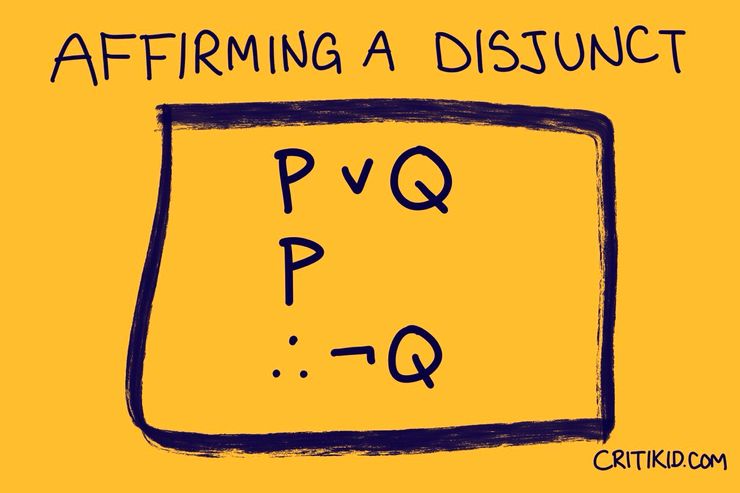
Affirming a Disjunct
My doctor told me the medication may cause nausea or dizziness. It’s causing nausea. At least I know I won’t get dizzy!
Affirming a disjunct takes this form:
P or Q.
P.
Therefore, not Q.
In the previous example,
P: The medication may cause nausea.
Q: The medication may cause dizziness.
It is a fallacy because P and Q can both be true.
Statements like this are not always fallacies because or has two meanings:
- one or the other or both (inclusive or)
- one or the other but not both (exclusive or)
If a waiter says, “Your burger comes with a free salad or fries,” he probably means that you can only get one of them for free. This is the exclusive or.
In formal logic, or is always inclusive. It is written with the symbol ∨. Therefore, it would be more exact to write the fallacy like this:
P ∨ Q.
P.
Therefore, not Q.
Introduce your teens to formal logic through Critikid's Logic for Teens.